
Bitget Exchange
Bitget Exchange is renowned for its robust derivatives trading platform and integrated copy-trading functionality.[source]
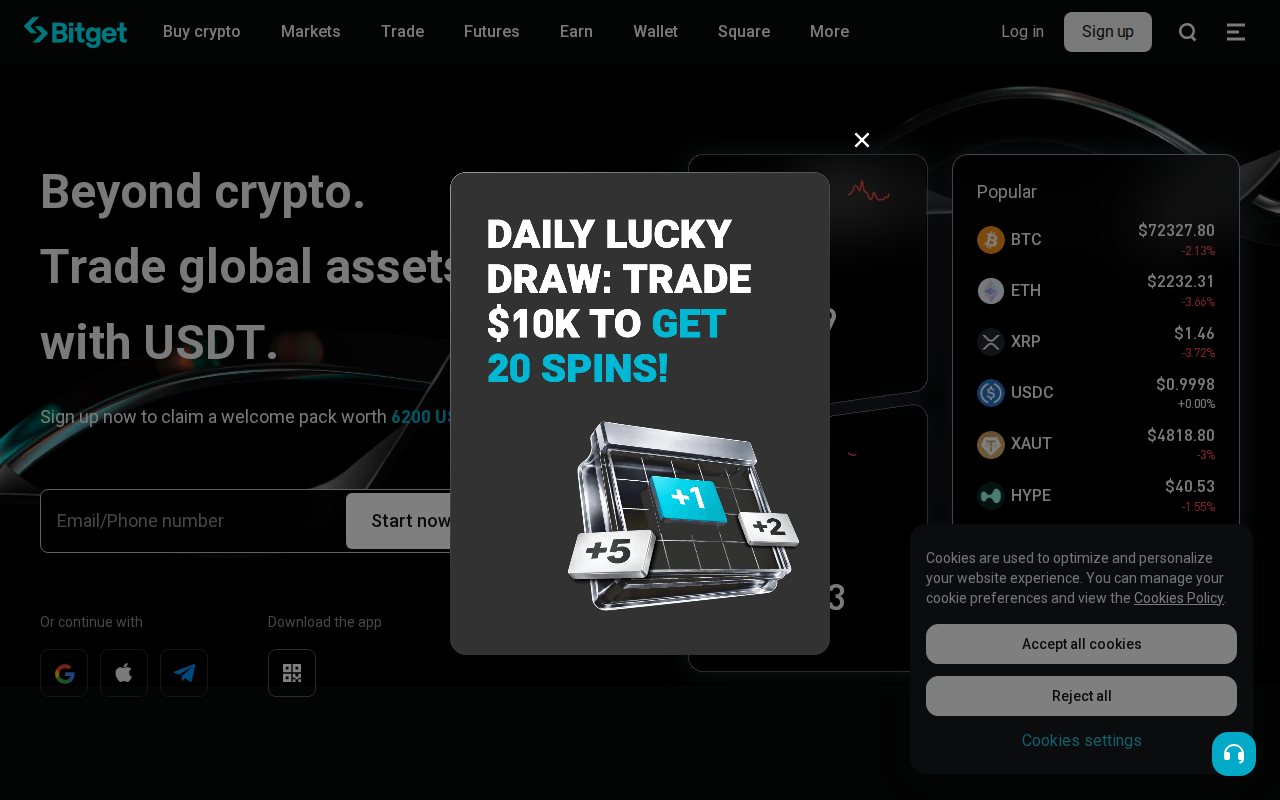
What you should know about Bitget Exchange
- Leading Copy Trading: One of the world’s largest platforms for one-click copy trading, allowing users to follow and replicate pro traders automatically.
- Robust Security & Funds: Maintains a 00M+ Protection Fund and provides Proof of Reserves (PoR) with 100%+ collateralization to ensure asset safety.
- Low Fees & BGB Discounts: Highly competitive trading fees (0.1% spot) with an additional 20% discount when paying with the native BGB token.
- Deep Liquidity: Ranks consistently among the top exchanges globally for trading volume and liquidity depth, especially for BTC and ETH pairs.
Pros & Cons
Strengths
- + Extensive asset variety (1300+ coins)
- + Competitive fees with BGB discounts
- + Leading copy trading functionality
- + Strong security with $300M+ Protection Fund
- + Robust derivatives market
Weaknesses
- - Mandatory KYC for all services
- - Not available to US customers
- - Limited regulatory oversight in major jurisdictions
- - Custodial platform (User does not hold private keys)
Facts about the Bitget Exchange
Why use Bitget Exchange
Bitget Exchange sets itself apart from industry giants like Binance and Bybit primarily through its industry-leading Copy Trading platform. While Binance and Bybit cater heavily to advanced professional traders with complex tooling and extreme market depth, Bitget focuses on making profitable trading accessible to everyone. Their social trading ecosystem allows you to seamlessly discover, evaluate, and automatically mirror the strategies of elite traders in real-time. This makes it a vastly superior choice for beginners or passive investors who want exposure to advanced crypto derivatives without constantly monitoring the markets.
In addition to social trading, Bitget uniquely differentiates itself with its deep Web3 wallet integration directly inside the exchange interface, blending the lines between centralized trading and decentralized finance. Combined with a consistently overcollateralized Proof of Reserves and a massive, growing Customer Protection Fund, Bitget provides a user-friendly, socially-driven alternative that doesn't compromise on security.
Bitget Exchange FAQ
How do Bitget's spot trading fees compare to industry standards, and are there ways to reduce them?
Bitget charges a highly competitive base maker and taker fee of 0.01% for spot trading. This is significantly lower than many competing exchanges, making it highly attractive for high-frequency and volume traders. Users can further optimize these costs by utilizing the platform's native token or reaching higher VIP tiers based on their trading volume.
What are the specific identity verification requirements for new users on Bitget?
Mandatory Know Your Customer (KYC) identity verification is strictly enforced for all users before they can engage in trading activities or initiate withdrawals. The process typically involves submitting government-issued identification and passing a facial recognition check to comply with global Anti-Money Laundering (AML) regulations.
Can users located in the United States access Bitget's spot or derivatives trading markets?
No, Bitget strictly prohibits users located in the United States from accessing its services. This restriction is outlined in their terms of use and is enforced through IP blocking and stringent KYC checks, meaning US residents cannot legally create accounts or trade on the platform.
How does the native copy trading feature function, and what are the associated risks?
Bitget offers integrated one-click copy trading, allowing users to automatically mirror the portfolios and active trades of top-performing traders on the platform. While this offers a hands-off approach for beginners, it carries inherent risks, as past performance does not guarantee future results, and users remain exposed to the volatility and potential losses incurred by the traders they follow.
How does Bitget prove the safety and 1:1 backing of user assets held on the exchange?
Bitget regularly publishes and updates its Proof of Reserves, demonstrating that user assets are backed at least 1:1 on the platform. While this provides a layer of transparency regarding solvency, users must remember that the exchange remains custodial; you do not control the private keys, which introduces counterparty and potential hack risks.
Bitget Exchange FAQ
How does Bitget's native copy-trading algorithm manage slippage and order execution during periods of high market volatility?
Bitget's one-click copy trading engine is designed to execute follower orders synchronously with the lead trader's actions. However, during extreme market volatility, latency can introduce slippage. To mitigate this, the platform allows followers to configure maximum slippage limits and custom leverage parameters independently from the lead trader. If the execution price breaches the predefined slippage tolerance, the mirrored trade is automatically aborted to protect the follower's capital from unfavorable entries.
Are there specific tier-based requirements to maintain the ultra-low 0.01% spot trading fee on the platform?
Unlike many competitors that require massive 30-day trading volumes or significant native token holdings to access their lowest fee tiers, Bitget offers an extraordinarily low baseline spot trading fee of 0.01% for both makers and takers as a standard rate. This democratization of institutional-grade fees allows retail traders to execute high-frequency and arbitrage strategies without the burden of escalating tier requirements, though promotional periods and specific asset pairs should be monitored for any deviations.
What cryptographic methodologies does Bitget employ to ensure the validity of its publicly published Proof of Reserves?
Bitget utilizes an advanced cryptographic framework based on Merkle trees to validate its Proof of Reserves (PoR). This structure allows individual users to independently verify that their specific account balances are included in the global snapshot without exposing the data of other users. Furthermore, the exchange continuously maintains a reserve ratio exceeding 100%, meaning all user assets are backed at least 1:1 by securely custodied on-chain funds, protecting clients against insolvency risks.
How strict is the geographic fencing regarding United States residents, and can it be bypassed using a Virtual Private Network (VPN)?
Bitget maintains a strict prohibition on users residing in or holding citizenship in the United States, aligning with the complex regulatory environment enforced by US financial authorities. The exchange utilizes robust IP tracking and requires mandatory Know Your Customer (KYC) identity verification for all trading and withdrawal activities. Attempting to bypass these restrictions using a VPN is a violation of the terms of service and will result in the immediate freezing of the account and confiscation of assets upon detection during the KYC process.
How does the mandatory KYC verification process impact the withdrawal limits and overall liquidity access for new institutional accounts?
Mandatory identity verification is a prerequisite for utilizing any of Bitget's core services, including spot and derivatives trading. For institutional accounts, the KYC process is more rigorous, requiring corporate documentation and beneficial ownership disclosure. Once successfully verified, institutional clients are granted significantly higher daily withdrawal limits compared to retail users, ensuring they have the necessary liquidity access to execute large-scale portfolio rebalancing and cross-exchange arbitrage without encountering throttling mechanisms.