
Bitfinex Exchange
Bitfinex Exchange provides advanced trading features, including margin trading and peer-to-peer funding, aimed at professional traders and global liquidity providers.[source]
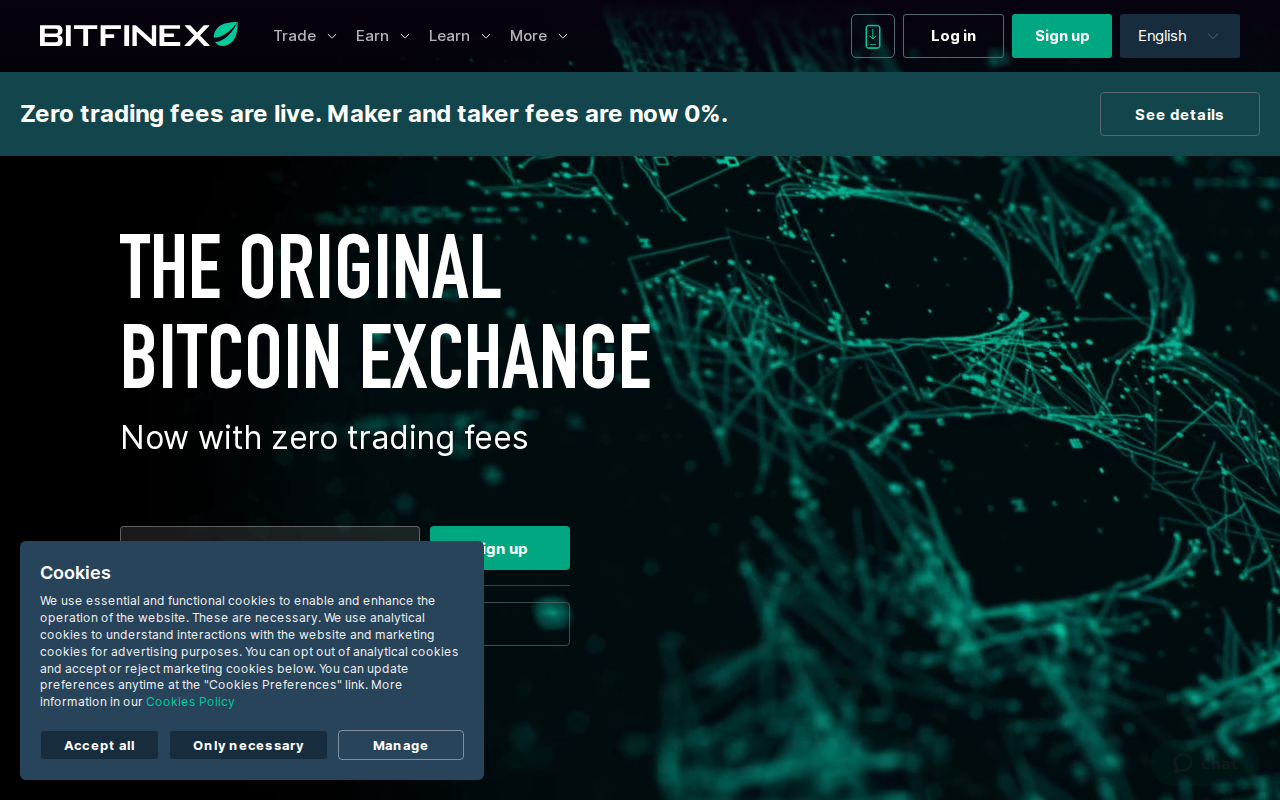
What you should know about Bitfinex Exchange
- High Liquidity for Pro Traders: One of the world’s oldest exchanges, offering deep liquidity and advanced order types tailored for high-volume and institutional trading.
- Margin & Lending Ecosystem: Renowned for its peer-to-peer margin funding market, allowing users to lend their assets to traders in exchange for interest.
- Historical Resilience: Despite major security breaches in the past, it has consistently reimbursed users and maintains high-security standards today (including mandatory 2FA).
- Deep Tether (USDT) Integration: Shares parent company iFinex with Tether, leading to seamless USDT integration but also attracting significant regulatory scrutiny over the years.
Pros & Cons
Strengths
- + Zero trading fees for all users
- + Deep liquidity for professional traders
- + Advanced trading tools and order types
- + Supports Lightning Network deposits/withdrawals
Weaknesses
- - US Customers strictly prohibited
- - No formal cryptographic Proof of Reserves
- - Mandatory KYC for all features
- - Custodial platform
Facts about the Bitfinex Exchange
Bitfinex Exchange Topics
Bitfinex Exchange FAQ
How does the fee structure scale for high-volume traders on Bitfinex?
Bitfinex employs a tiered fee schedule that rewards high-volume traders and liquidity providers. While the base maker fee starts at 0.10% and the taker fee at 0.20%, traders can significantly reduce these costs by increasing their 30-day trading volume or holding the UNUS SED LEO token. At the highest tiers, maker fees can drop to zero, while taker fees scale down substantially.
What advanced funding and margin capabilities are available on the platform?
The exchange offers robust margin trading with up to 10x leverage. Rather than a standard lending pool, Bitfinex operates a peer-to-peer funding market where users can supply liquidity for margin traders. This allows you to set your own interest rates and duration for loans, providing an opportunity to earn yield on your capital, or to borrow funds dynamically based on market demand.
How does the integration of the Lightning Network improve deposit and withdrawal efficiency?
By fully supporting the Lightning Network, Bitfinex allows users to bypass the congestion and higher fees typically associated with mainchain Bitcoin transactions. This integration facilitates near-instantaneous and highly cost-effective Bitcoin transfers, which is especially beneficial for arbitrageurs and active traders who need to move capital swiftly between platforms or self-custody wallets.
What are the compliance and identity verification requirements for institutional and retail clients?
Bitfinex maintains strict regulatory compliance, meaning mandatory Know Your Customer verification is enforced for all trading and fiat deposit activities. Users must complete comprehensive identity checks to access the platform's full suite of features, including fiat gateways for USD, EUR, GBP, and JPY. Notably, the platform strictly prohibits residents and citizens of the United States from onboarding or utilizing its services.
What role does the UNUS SED LEO token play in the Bitfinex ecosystem?
The UNUS SED LEO token is central to the exchange's utility and economic model. Holders of the token receive percentage-based discounts on trading fees, lending fees, and withdrawal fees across the platform. The exact discount depends on the amount of LEO held in the user's account, creating a strong incentive for frequent traders to maintain a balance of the token to optimize their operational costs.
Bitfinex Exchange FAQ
How does Bitfinex structure its maker and taker fees, and how can traders optimize their costs?
Bitfinex utilizes a competitive volume-based fee schedule, starting with a base maker fee of 0.10% and a taker fee of 0.20% for spot trading. High-frequency traders can significantly reduce these rates by increasing their 30-day trading volume. Furthermore, users who hold the native UNUS SED LEO token in their accounts receive additional fee discounts, providing a compounded reduction in execution costs for active market participants.
What are the specific requirements and compliance measures for initiating fiat deposits?
To facilitate seamless onboarding, Bitfinex supports direct fiat deposits in major currencies including USD, EUR, GBP, and JPY. However, to comply with international anti-money laundering regulations, the platform enforces mandatory Know Your Customer (KYC) verification. Users must complete full identity verification, submitting government-issued identification and proof of residence, before they are permitted to deposit fiat currency or execute trades on the exchange.
Are residents or citizens of the United States permitted to utilize the exchange's trading features?
No, Bitfinex strictly prohibits residents and citizens of the United States from accessing its platform. Due to the complex and stringent regulatory environment enforced by US financial authorities, the exchange restricts all trading, margin, and funding services for US individuals and corporate entities. Attempting to bypass these geographic restrictions violates their terms of service.
How does the platform's margin trading feature leverage the peer-to-peer funding market?
Bitfinex offers robust margin trading capabilities, allowing users to trade with up to 10x leverage. Rather than relying solely on exchange-provided liquidity for these borrowed funds, Bitfinex operates an innovative peer-to-peer (P2P) margin funding market. This system allows users to securely lend their idle digital assets or fiat currencies to margin traders, earning interest at rates determined by real-time supply and demand dynamics within the order book.
What advantages does Bitfinex's native integration with the Bitcoin Lightning Network provide?
Bitfinex offers native support for the Bitcoin Lightning Network, acting as a critical Layer 2 scaling solution. This integration allows users to execute Bitcoin deposits and withdrawals with near-instant settlement times and negligible transaction fees. By bypassing the congestion and higher miner fees of the Bitcoin base layer, it is highly advantageous for arbitrageurs and retail traders looking to move capital rapidly and cost-effectively.
Bitfinex Exchange FAQ
How do the volume-based trading fees structure and the LEO token integrate on Bitfinex?
Bitfinex applies a base maker fee of 0.10% and a base taker fee of 0.20% for spot trading. Traders can significantly reduce these baseline costs by increasing their 30-day trading volume or by holding the platform's native utility token, UNUS SED LEO. Holding LEO provides tiered fee discounts that stack with volume-based reductions, optimizing trading costs for high-frequency and institutional participants.
Are United States residents permitted to utilize the margin trading facilities?
No, United States customers are strictly prohibited from utilizing any services on the Bitfinex platform, including spot and margin trading. The exchange enforces geographic restrictions and mandatory KYC verification protocols to ensure compliance with international regulatory frameworks, permanently barring US-based IP addresses and identities.
What are the exact leverage limits and mechanisms for margin trading on the platform?
Bitfinex offers advanced margin trading capabilities allowing users to trade with up to 10x leverage. This leverage is facilitated through a proprietary peer-to-peer margin funding market, where users can borrow the necessary capital from other platform participants at market-driven interest rates, allowing for sophisticated shorting and leveraged long strategies.
How does the platform handle high-frequency, low-cost Bitcoin transfers?
To accommodate rapid and cost-effective Bitcoin movements, Bitfinex fully integrates the Lightning Network. This Layer-2 scaling solution enables users to execute nearly instantaneous Bitcoin deposits and withdrawals with minimal transaction overhead, bypassing the latency and higher fees typically associated with mainchain Bitcoin transactions.
What fiat currency onboarding options exist and what are the verification prerequisites?
The exchange supports robust fiat onboarding gateways, accepting deposits in major international currencies including USD, EUR, GBP, and JPY. However, accessing these fiat ramps and executing trades requires users to complete a mandatory, comprehensive Know Your Customer (KYC) verification process, ensuring strict adherence to global Anti-Money Laundering (AML) standards before any capital deployment.
Bitfinex Exchange FAQ
How does Bitfinex's peer-to-peer (P2P) margin funding system actually function for liquidity providers?
Bitfinex allows users to provide funding to traders wanting to trade with leverage. Providers can offer funding across various currencies and assets at customized rates and durations. This creates a market-driven interest rate. When a trader accepts an offer, the funds are locked in the trader's margin wallet, and the provider accrues interest daily until the position is closed or the funding duration expires.
What advanced order types are uniquely available to algorithmic traders via the Bitfinex API?
Beyond standard limit and market orders, the Bitfinex API and advanced UI support algorithmic order types like Iceberg orders (which hide the total order size), Fill or Kill (FOK), Immediate or Cancel (IOC), and complex Trailing Stop variants. The platform also offers Scaled orders to automatically distribute multiple limit orders across a defined price range, allowing traders to enter or exit positions gradually without writing custom scripts.
How does Bitfinex integrate the Lightning Network, and what are the specific benefits for high-frequency transfer users?
Bitfinex was an early adopter of the Lightning Network for Bitcoin deposits and withdrawals. By operating its own well-connected Lightning nodes, Bitfinex enables near-instantaneous and low-cost Bitcoin transfers. This is especially advantageous for high-frequency traders and arbitrageurs who need to move capital swiftly between exchanges or personal wallets without waiting for on-chain block confirmations or paying high miner fees.
Can you explain the role of UNUS SED LEO tokens in the Bitfinex fee tier ecosystem?
UNUS SED LEO is the utility token of the iFinex ecosystem, which includes Bitfinex. Holding LEO tokens provides traders with tiered trading fee discounts on both crypto-to-crypto and crypto-to-fiat pairs. Additionally, it offers reductions on lending fees within the P2P margin funding market and withdrawal or deposit fee rebates. The fee reductions dynamically scale based on the average amount of LEO held in the user's account over the preceding 30 days.
What security measures protect user funds held in Bitfinex's cold storage infrastructure?
Bitfinex stores the overwhelming majority of user funds in offline, multi-signature cold wallets. Access to these wallets requires the physical presence and coordinated action of multiple key holders globally distributed. Furthermore, the exchange employs hardware security modules (HSMs) and mandates withdrawal address whitelisting, U2F (Universal 2nd Factor) authentication, and IP whitelisting to prevent unauthorized access at the individual account level.
Bitfinex Exchange FAQ
How does the UNUS SED LEO token influence the tiered fee structure on the Bitfinex trading platform?
Holding LEO tokens provides a progressive discount on both maker and taker fees. Unlike flat-rate exchanges, Bitfinex utilizes a dynamic fee schedule where the base rates of 0.10% for makers and 0.20% for takers are significantly reduced based on a trader's 30-day volume and their aggregate LEO token holdings, strategically incentivizing long-term liquidity provision and capital efficiency.
What are the specific regulatory limitations preventing United States residents from accessing the Bitfinex platform?
Due to the stringent and complex regulatory environment enforced by United States financial authorities such as the SEC and CFTC, Bitfinex strictly prohibits US citizens and residents from utilizing its services. The platform explicitly enforces this geographic restriction through its mandatory Know Your Customer (KYC) identity verification protocols, actively barring US-based IP addresses and identifying documents from the onboarding process.
How does the integration of the Bitcoin Lightning Network on Bitfinex benefit high-frequency arbitrage traders?
By natively supporting the Bitcoin Lightning Network, Bitfinex enables near-instantaneous and virtually feeless BTC deposits and withdrawals. This Layer-2 integration allows high-frequency arbitrageurs and algorithmic traders to rapidly move capital between supported exchanges to capture fleeting price discrepancies, entirely bypassing the congestion and high transaction costs typically associated with the Bitcoin base layer.
What is the core distinction between standard spot trading and the up to 10x margin trading facility provided by Bitfinex?
While standard spot trading involves the direct exchange of assets using fully funded account balances, the margin trading facility allows users to borrow capital directly from the platform's peer-to-peer funding market to leverage their positions up to 10x. This mechanism amplifies both potential profits and potential losses, requiring traders to maintain a strict maintenance margin to prevent the automated liquidation engine from forcefully closing their positions during periods of extreme market volatility.
How does the mandatory KYC verification process impact the onboarding timeline for institutional fiat deposits?
Bitfinex requires comprehensive KYC verification before any fiat deposits, including USD, EUR, GBP, or JPY, can be processed. For institutional clients, this involves a rigorous compliance review that requires extensive corporate documentation and beneficial ownership disclosure. While this thorough vetting ensures strict adherence to global anti-money laundering (AML) standards, it significantly extends the initial onboarding timeline before large-scale fiat capital can be successfully deployed into the market.