
Binance Exchange
Binance Exchange is the largest crypto exchange by trade volume, offering hundreds of crypto assets.
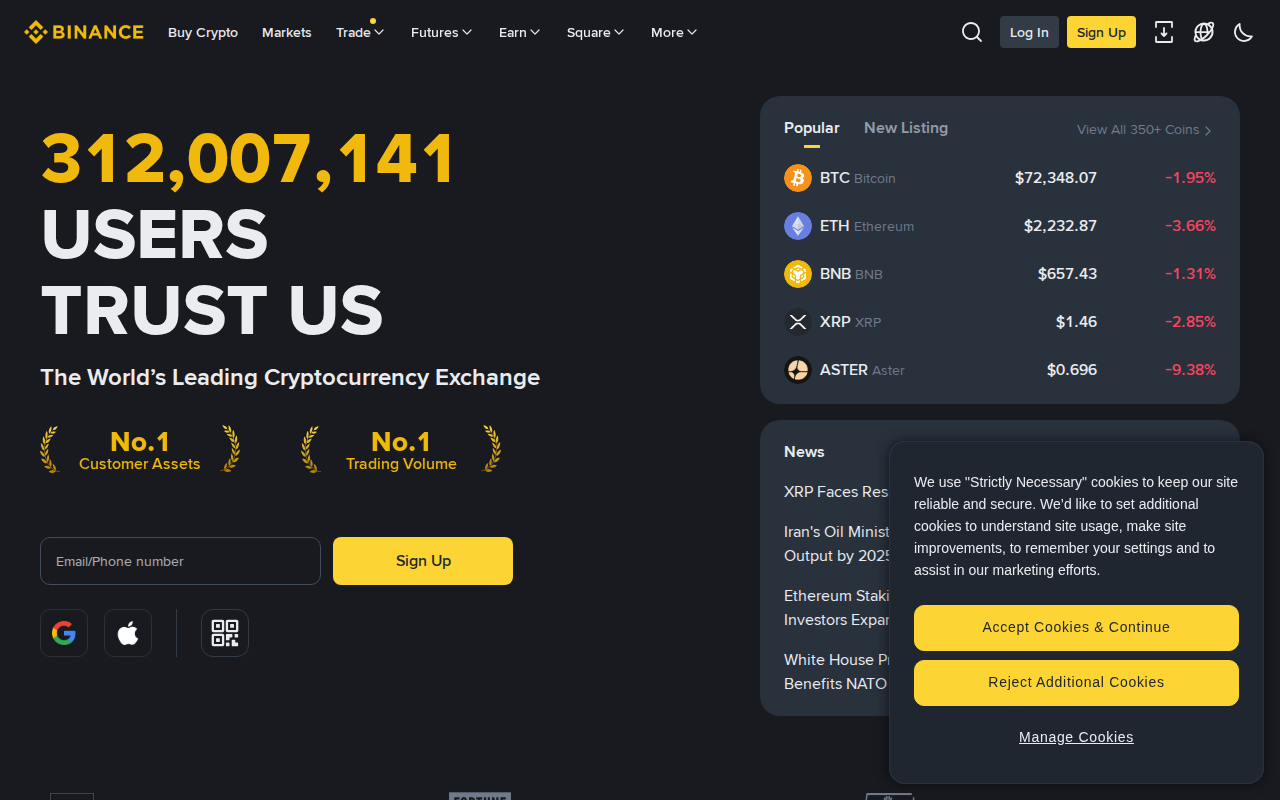
Binance Exchange
- Industry-Leading Liquidity: As the world’s largest exchange, Binance offers the highest trading volumes, ensuring fast execution and minimal slippage for almost any crypto pair.
- Competitive Fee Structure: Standard trading fees start at a low 0.1%, with further discounts available if you pay with BNB (25% off) or reach higher VIP levels based on trading volume.
- Comprehensive Security Suite: Features robust protection including 2FA, whitelisting, and the SAFU fund (Secure Asset Fund for Users), which acts as an emergency insurance reserve.
- Advanced Trading Tools: Provides access to a massive range of products including spot, futures, options, and staking, making it suitable for both beginners and professional traders.
Pros & Cons
Strengths
- + Industry-leading liquidity and volume
- + Very low trading fees (0.1% or less)
- + Massive selection of 350+ cryptocurrencies
- + Advanced trading features and comprehensive ecosystem
Weaknesses
- - Complex interface for beginners
- - Strict KYC requirements
- - Not available for US residents
- - Regulatory history and ongoing scrutiny
Facts about the Binance Exchange
Binance Exchange Topics
Binance Exchange FAQ
How does Binance structure its spot trading fees, and are there ways for traders to reduce them?
Binance maintains a highly competitive fee structure for spot trading, featuring a standard base fee of 0.10% for both makers and takers. Traders can further reduce these costs by holding and paying fees with Binance Coin (BNB), which typically grants a substantial discount, or by achieving higher VIP tiers through increased 30-day trading volume.
What mechanisms does Binance use to prove that customer assets are securely held?
To provide transparency and maintain user trust, Binance publishes regular Proof of Reserves (PoR) reports. These reports utilize zk-SNARKs and Merkle tree cryptography, allowing users to independently verify that their digital assets are backed at least 1:1 on the platform without compromising individual account privacy.
Are residents and citizens of the United States permitted to use the main Binance platform?
No, the primary Binance.com platform strictly restricts access for users located in the United States due to complex regulatory requirements. US residents must instead utilize the entirely separate Binance.US platform, which operates independently to comply with United States financial regulations.
What are the exact identity verification prerequisites for depositing and trading on Binance?
Binance enforces a strict, mandatory Know Your Customer (KYC) policy. All users must successfully complete full Identity Verification, which involves submitting government-issued identification and passing facial recognition checks, before they are permitted to deposit fiat or crypto, execute trades, or process withdrawals.
How do withdrawal limits function on the platform, and what is the base capacity for verified users?
Withdrawal limits on Binance are tier-based and scale with a user's VIP status and verification level. For standard users who have completed the mandatory identity verification, the daily withdrawal limit is typically set to the equivalent of 8 million BUSD, providing substantial liquidity access for retail traders.